

Hocking Hills draws up to five million visitors a year, which makes it the most visited natural area in Ohio. That popularity is well earned, but it also means the difference between a peaceful morning at Old Man’s Cave and a crowded scramble for parking often comes down to timing.
This guide covers the best time to visit Hocking Hills across every season and every month of the year. You will also find the quietest trails in the park, the preserves most visitors never reach, and the practical tricks that make even a peak October weekend feel manageable.
Best Time to Visit Hocking Hills, Month by Month
The best time to visit Hocking Hills is late April through May, or the first two weeks of November. Both windows give you strong trail conditions with a fraction of the peak-season crowd.
| Month | Crowds | What you get |
| January | Very light | Frozen waterfalls, bare-tree views, near solitude |
| February | Very light | Ice formations, the quietest hiking of the year |
| March | Light | Waterfalls waking up, muddy trails |
| April | Light to moderate | Peak water flow, wildflowers, still uncrowded |
| May | Moderate | Full green canopy, strong flow, builds toward Memorial Day |
| June | Heavy | School holidays begin, cool gorges, slowing falls |
| July | Heavy | Hottest month, busiest weekends, lots full by mid-morning |
| August | Heavy | Still busy, waterfalls at their lowest |
| September | Moderate | An underrated month, warm days and thinning crowds |
| October | Very heavy | Peak fall color, the busiest weekends of the year |
| November | Light | Bare ridgelines, long views, returning water flow |
| December | Very light | Quiet trails, early sunsets, first ice |
The short version: avoid June through August weekends and all of October if crowds bother you. Aim for April, May, September, or November instead.
The Best Time to Visit Hocking Hills, Season by Season

Hocking Hills State Park is open every day of the year, dawn until dusk. There is no admission fee, no parking fee, and no gate. Because the park never closes for a season, the only real variable in planning your trip is how many other people share the trail with you.
Spring: Peak Water, Light Crowds (March through May)
Spring is the strongest season for moving water in Hocking Hills. Snowmelt and steady rain push Cedar Falls, Ash Cave, and the Old Man’s Cave falls to their fullest volume of the year. Trillium, violets, and Dutchman’s breeches come up across the forest floor through April.
Trails stay muddy well into May, so waterproof boots earn their keep. Crowds hold light through most of April, then climb steadily as Memorial Day approaches.
There is something about an April morning in the gorge that the busier months never quite match. The water is loud, the canopy has not filled in yet, and you can go a long stretch without passing anyone. Our guide to the best waterfalls in Hocking Hills breaks down which falls run hardest and when.
🗓 Best time to visit: mid-April through mid-May, before the Memorial Day rush.
Summer: Cool Gorges, Full Parking Lots (June through August)
Summer is peak family season in Hocking Hills. Days run long; the hemlock canopy keeps the gorges genuinely cool, and the temperature at the bottom of a ravine sits noticeably below that of the parking lot above it.
The waterfalls are the trade-off. Most slow to a trickle by July, and some stop altogether. Parking becomes the real obstacle, with the Old Man’s Cave lot filling by mid-morning on nearly every summer weekend.
Summer still works beautifully if you plan around it. A Tuesday in July can feel emptier than a Saturday in March, and the shaded trails are a relief when the humidity settles in.
🗓 Best time to visit: any weekday, arriving before 9 a.m.
Fall: The Busiest and the Most Beautiful (September through November)
Fall brings the heaviest visitation of the entire year to Hocking Hills. Color usually peaks across the middle two weeks of October, and those weekends are the single hardest days to find parking anywhere in the park.
What most visitors miss is how quiet the edges of the season are. Early September holds warm weather with a fraction of the summer crowd. The first half of November, once the leaves are down, opens ridgeline views you cannot see any other time of year.
ODNR publishes an Ohio Fall Color Report each autumn to track peak timing across the state, with the first update for 2026 due on September 25. Our post on fall in Hocking Hills covers the color season and its festivals in more depth.
🗓 Best time to visit: the first two weeks of September, or the first two weeks of November.
Winter: Ice, Silence and the Whole Park to Yourself (December through February)
Winter is the quietest season in Hocking Hills by a wide margin, and it rewards anyone willing to dress for it. During a sustained cold snap, Ash Cave Falls can freeze into a towering ice pillar that fills the cave entrance, one of the most striking sights in Ohio.
Bare trees open sightlines through the gorges that summer foliage hides completely. Stone stairways ice over and stay slick, so traction cleats are worth packing for winter hikes in Hocking Hills. Daylight is short, so plan shorter routes and start earlier than you think you need to.
For guests who want a warm indoor option on the coldest days, our roundup of indoor activities in Hocking Hills covers what stays open through the season.
🗓 Best time to visit: any weekday in January or February, after a cold snap.
When Is Hocking Hills Busiest?
Hocking Hills is busiest on October weekends during peak fall color. Peak tourism season runs from Memorial Day through mid-October, according to the Hocking Hills Tourism Association, which estimates that up to 5 million visitors come to the region each year.
There is no official monthly attendance count for the park. Admission is free, and there is no gate, so nobody tallies visitors the way a national park does. Local records consistently show that autumn weekends produce the largest single-day crowds of the year.
The pattern repeats at a smaller scale too. Saturday runs heavier than Sunday, and Sunday runs heavier than any weekday. That holds true in almost every month.
What Is the Best Day of the Week to Visit Hocking Hills?
Tuesday through Thursday are the quietest days at every trailhead in the park. A midweek trip during peak October can feel emptier than a Saturday in March, which is worth remembering if your dates are flexible at all.
If your dates are fixed to a weekend, the hour you arrive matters far more than the day you choose.
- Arrive at dawn. The parks open at dawn, and the first hour is nearly empty. Old Man’s Cave fills first, so start there and work outward toward the quieter areas.
- Or come late. Most day visitors clear out by four o’clock. The last two hours of daylight are nearly as quiet as the first, with better light for photographs.
- Watch for light rain. A drizzly forecast thins the trails faster than anything else. Sandstone turns slippery when wet, so slow down on the stairs and stay behind railings.
- Skip holiday Mondays. Memorial Day, July 4th, and Labor Day weekends run heavier than ordinary weekends across all three days.
5 Quieter Trails in Hocking Hills State Park
Cantwell Cliffs, Rock House, Conkle’s Hollow, Whispering Cave, and Rockbridge State Nature Preserve stay reliably calmer than Old Man’s Cave. All five are free, need no permit, and sit within a reasonable drive of the main park cluster. Each one trades a little convenience for a lot of quiet.
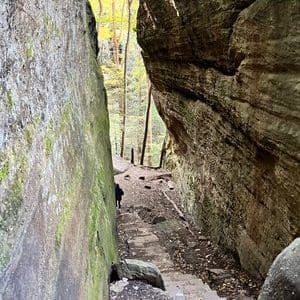
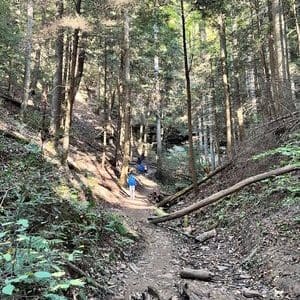
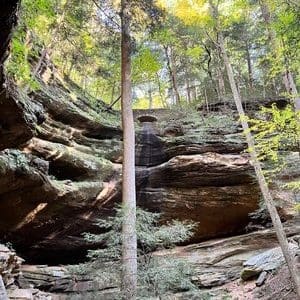
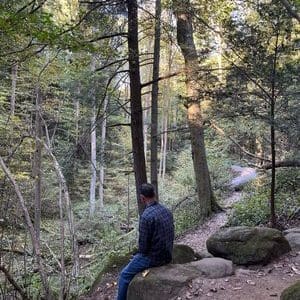
1. Cantwell Cliffs
📍 Cantwell Cliffs Trail, State Route 374 | 🥾 1 to 2 miles | Challenging
Cantwell Cliffs sits at the remote northern edge of the park, and that extra driving time does most of the work of keeping crowds away. The trail drops into a dramatic box canyon by way of steep staircases, including a narrow squeeze between boulders that locals call the Fat Woman’s Squeeze.
Why Visit?
✔ The most remote of the seven main hiking areas
✔ Dramatic box canyon with sheer walls on every side
✔ Genuinely quiet even on peak fall weekends
✔ Seasonal waterfall runs after rain or snowmelt
✔ Plan 60 to 80 minutes for the full loop
Cantwell Cliffs is the one place in the park where you can stand on a peak October Saturday and hear nothing but water. That is worth a twenty-minute drive.
2. Rock House
📍 Rock House Trail, State Route 374 | 🥾 1 mile | Moderate
Rock House is the only true cave in Hocking Hills, a tunnel-like corridor cut straight through a sandstone cliff with natural windows opening along its length. It sits well north of the Old Man’s Cave cluster and sees a fraction of that traffic.
Why Visit?
✔ The only true cave in the park, not a recess shelter
✔ Natural stone windows along the corridor
✔ One of the least crowded trails in the park year-round
✔ Seasonal waterfall forms near the entrance after heavy rain
Rock House tends to draw a quieter, more curious crowd. It rewards visitors who slow down long enough to notice the details in the stone.
3. Conkle’s Hollow
📍 Conkle’s Hollow State Nature Preserve, Big Pine Road | 🥾 0.5 miles (gorge) or 2.5 miles (rim) | Easy to Moderate
Conkle’s Hollow holds the deepest gorge in Ohio, with cliff walls rising sharply on both sides. Two very different trails run here. The paved gorge floor trail is level and accessible, while the rim trail climbs to unfenced clifftop views that are genuinely rare in this part of the state.
Why Visit?
✔ Deepest gorge in Ohio
✔ Accessible paved gorge trail suitable for strollers and wheelchairs
✔ Panoramic rim views found almost nowhere else in Hocking Hills
✔ The rim trail thins out even when the parking lot is full
✔ No pets permitted, as this is a state nature preserve
The rim trail runs along unprotected cliff edges without railings, so it is not appropriate for young children or anyone uneasy about heights. The gorge floor trail below offers the same scenery from a safer vantage point.
4. Whispering Cave
📍 Hemlock Bridge Trail, from the Old Man’s Cave area | 🥾 2 miles round trip | Moderate
Whispering Cave is reached by the Hemlock Bridge Trail out of Old Man’s Cave, crossing a suspension bridge on the way in. The waterfall drops more than 100 feet into a recess cave stretching roughly 300 feet wide.
Why Visit?
✔ 100-foot seasonal waterfall into a 300-foot recess cave
✔ The two-mile distance filters out most casual visitors
✔ Suspension bridge crossing along the way
✔ Starts from the busiest trailhead but empties out quickly
The interesting thing about Whispering Cave is how close it sits to the busiest spot in the park while feeling nothing like it. Most of the crowd at Old Man’s Cave turns back long before the bridge.
5. Rockbridge State Nature Preserve
📍 Rockbridge State Nature Preserve, Dalton Road | 🥾 2.5 miles round trip | Moderate
Rockbridge holds the largest natural bridge in Ohio, a sandstone span roughly 100 feet long arcing over the valley below. It sits entirely outside the main park cluster, north toward Rockbridge, which keeps visitor numbers low year-round.
Why Visit?
✔ The largest natural bridge in Ohio
✔ Well outside the main park cluster, so consistently quiet
✔ Open meadow sections that feel different from the gorge trails
✔ Good spring wildflower viewing
Rockbridge is the kind of place that first-time visitors drive past without knowing it is there. It is worth the detour on a busy weekend when the main lots are gone.
For more trails beyond the state park, see our guides to the best hikes in Hocking Hills and hidden gems near Hocking Hills.
Preserves You Need a Permit to Enter
Six nature preserves in Hocking County are closed to walk-in visitors. Little Rocky Hollow, Sheick Hollow, Crane Hollow, Bison Hollow, Boch Hollow at Laurel Falls, and Saltpetre Cave all require a written permit or a scheduled guided hike. These are the quietest protected places in the region, and almost nobody plans a trip around them.
| Preserve | Acres | How to access |
| Little Rocky Hollow | 259 | Written permit from ODNR |
| Sheick Hollow | 151 | Permit, capped at 16 per month, maximum 6 people each |
| Crane Hollow | 1,285 | Scheduled guided hikes only, through Crane Hollow, Inc. |
| Bison Hollow | 375 | Permit from the Appalachia Ohio Alliance |
| Boch Hollow at Laurel Falls | 35 | Permit required to leave the marked trails |
| Saltpetre Cave | 14 | Permit required; closed each year between October 1 and April 1 |
The permit process is simple, but it is not fast. ODNR must receive your application at least 14 days before your intended visit. ODNR emails permits at least seven days in advance and includes maps, directions, and any conditions specific to that preserve.
Boch Hollow is the useful exception for anyone planning at short notice. Roughly seven miles of marked trail there are open to everyone without a permit. You only need one to leave those trails and reach Laurel Falls, formerly called Robinson Falls, so older guides still use the old name.
If the permit timeline does not fit your trip, local outfitters run naturalist-led treks through the same country and handle the paperwork themselves. The Explore Hocking Hills tour directory lists current operators.
Use the Free Weekend Shuttle to Skip the Parking Lots
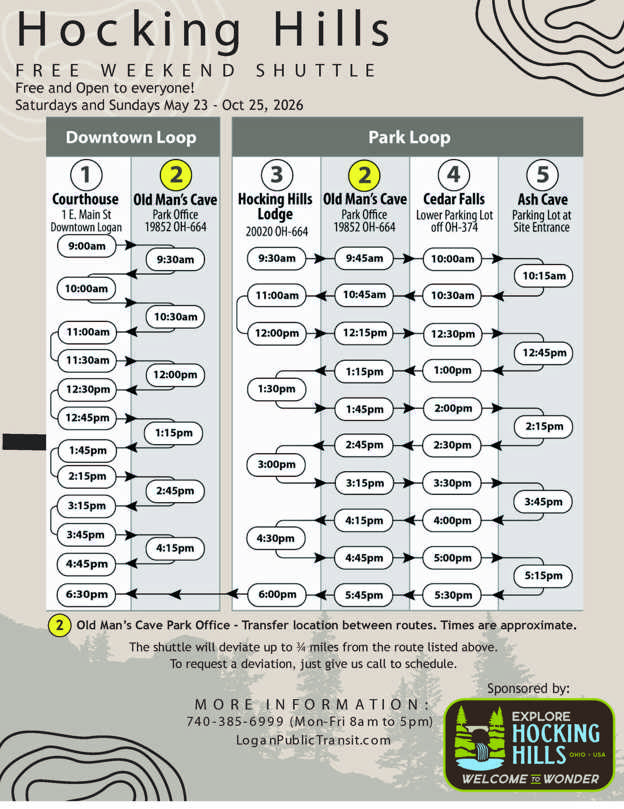
The Hocking Hills Shuttle runs Saturdays and Sundays, May 23 through October 25. The service is free, wheelchair-accessible, and welcomes leashed pets, making it one of the easiest wins available on a busy weekend.
Two loops run continuously. Loop one connects the Hocking County Courthouse lot in downtown Logan to the Old Man’s Cave park office. Loop two circulates between Old Man’s Cave, the Hocking Hills Lodge, Cedar Falls, and Ash Cave.
The practical value here is real. Park downtown, ride in, and the parking problem simply stops being your problem. You also get a reason to spend time in Logan before or after your hike, which is worth doing on its own.
Check the current schedule on the Hocking Hills Tourism Association shuttle page before you go, and take a photo of it while you still have signal. Cell service is unreliable across much of the park, and missing the last shuttle means arranging your own way back.
The shuttle operates through a partnership between the Hocking Hills Tourism Association and Logan Transit and supports the region’s Love Hocking Hills stewardship program.
Where to Go When the Main Parks Are Full
Lake Logan State Park, Cedar Falls, Boch Hollow State Nature Preserve, and Chapel Cave all remain open on days when the main lots are full by ten in the morning. Every one of them sits within a short drive of the gorges.
Lake Logan State Park is a 318-acre day-use park a short drive north of the main cluster. There is a swimming beach, three miles of walking paths, and a 400-acre lake open to boating and fishing. It is a good option with younger children when the trails feel like too much.
Cedar Falls is better known than the others here but consistently lighter than Old Man’s Cave. The waterfall carries the highest volume of any in the region, and the half-mile trail is easy enough for most fitness levels.
Boch Hollow State Nature Preserve offers roughly seven miles of marked trail through forest, streams, and meadows. Birdwatching is good, and foot traffic remains light year-round.
Chapel Cave is a large recess cave in Hocking State Forest, also known as Twenty One Horses Cave. This one needs more preparation than the others. The trailhead sits at the north end of the Rock Climbing and Rappelling Area parking lot on Big Pine Road. The route follows a white-blazed bridle trail; it is not signposted as a destination, and there are no restrooms or facilities along the way. Download a map before you leave, because cell service out there is unreliable.
What to Pack for a Quiet Hocking Hills Hike
- Waterproof boots with real grip. Sandstone stays slick long after rain, and the stairways at Old Man’s Cave and Cantwell Cliffs are steep.
- Traction cleats in winter. Ice forms on the stone steps and stays there. Microspikes turn a risky hike into an easy one.
- A downloaded offline map. Cell service drops out across most of the park, including at Cantwell Cliffs and Chapel Cave.
- More water than you think. There are no water stations on the trails, and the gorge climbs are more demanding than the mileage suggests.
- A headlamp for early starts. The parks open at dawn, and the first twenty minutes in a gorge are darker than the sky above it.
Best Time to Visit Hocking Hills: FAQs
May and November are the best months to visit Hocking Hills. May offers full green canopy and strong waterfall flow before the summer crowds arrive. November brings bare ridgeline views and returning water flow with very light visitation.
Weekday mornings in January and February are the least crowded. For milder weather, a Tuesday-through-Thursday visit in April or early November offers near solitude and far better conditions.
Yes, October weekends are the busiest days of the entire year in Hocking Hills. Peak fall color usually lands in the middle two weeks of October, and parking at Old Man’s Cave often fills before 9 a.m. October weekdays remain manageable.
Hocking Hills State Park is open from dawn until dusk, every day of the year, including holidays. There are no set gates or clock times, so opening hours shift with the seasons.
No. There is no admission or parking fee anywhere in Hocking Hills State Park. The park is managed by the Ohio Department of Natural Resources and is free to visit year-round.
You don’t need a permit for Hocking Hills State Park trails. Permits are only required for certain state nature preserves, including Little Rocky Hollow, Sheick Hollow, and Saltpetre Cave, and for off-trail access at Boch Hollow.
Arrive before 9 a.m. on weekends and during peak season. The Old Man’s Cave lot is the largest in the park and still fills by mid-morning on summer and fall weekends.
Yes. The Hocking Hills weekend shuttle is completely free, wheelchair accessible, and open to leashed pets. It runs Saturdays and Sundays, May 23 through October 25.
Ready to Plan Your Quiet Hocking Hills Getaway?

Where you sleep is part of the crowd strategy, not separate from it. Staying in the area is what makes a dawn start realistic, and visitors driving in from Columbus rarely reach a trailhead before the lots begin to fill. That single advantage changes the shape of the whole trip.
Woodland Lodge sleeps 18 across five bedrooms and three bathrooms, with a game room and theater room for the hours between hikes. Magnolia Grove Lodge sleeps 20 across seven bedrooms and four bathrooms, and is our only fully ADA-accessible property, with step-free entry and a wheelchair-accessible master suite. Both are well-suited to reunions, retreats, and multigenerational groups looking for large-group cabins in Hocking Hills.
Five percent of every booking goes to charity, chosen by our children. That is what Making a Difference One Stay at a Time means to our family, and it is the part of this work we are proudest of.
🌿 Ready to plan your trip? Remember to always book direct for the best rates. Check availability now and start planning your stay at The Woodlands at Hocking Hills.